Showing posts with label Travels of Sir John Mandeville. Show all posts

Monday, November 17, 2014

Cannibalism and Cultural Superiority

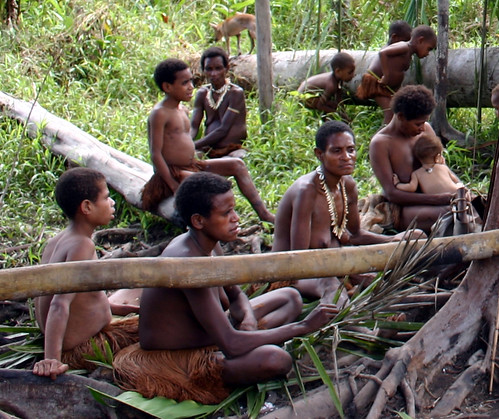
In The Travels of Sir John Mandeville, the author several times describes cannibalism occurring on islands east of Ind. In addition to the inhabitants of the islands being naked and having sex with many partners, they also greatly enjoy eating human flesh, even buying children from merchants to eat them. Given  Sir Mandeville's description of the islands, I would guess that the islands are part of countries we know today as Indonesia and Papua New Guinea. Cannibalism is believed to still exist among certain groups in New Guinea, but rather than eating it as regular food, New Guineans who practice cannibalism usually eat the flesh of a dead friend or family member as part of the mourning process, a practice called endocannibalism that Sir Mandeville also mentions. In addition, some communities eat people who have been accused of being witches.

The Korowai People only eat witches
Exaggerating or emphasizing certain cultural practices in order to make others look uncivilized is nothing new. Sir Mandeville may have done the same to excite his readers or exotify the people living on the islands. Early European colonizers in the Americas wrote of violent cultural practices, torture, and human sacrifice done by native Americans, but some scholars today believe that such accounts were exaggerated in order to dehumanize the natives and create justification for colonization. The French essayist Michel de Montaigne wrote of this cultural superiority in his 1653 essay "Des Cannibales." Montaigne had met 3 cannibals from Brazil, who had never left their homeland before and were visiting France for the first time. The cannibals explained to Montaigne things they found unusual, such as how some people had enormous wealth and ate everything, while some men were starving in the streets. According the them, it was strange that the poor tolerated such inequality and didn't kill the rich or burn their houses. Montaigne challenged European feelings of superiority over people like the Brazilian cannibals, arguing in his essay that some European practices were even more barbaric than the Brazilian custom of eating their dead enemies, and that the Brazilians in some ways were more humane. I would agree with him, considering that Europeans at the time, like some cannibals, killed accused witches and believed in all sorts of superstition. It seems that whether we consider a practice to be barbaric or not depends on what our culture deems normal.

https://www.flickr.com/photos/47372552@N06/4343341886/
http://opinionator.blogs.nytimes.com/2013/02/17/on-ethnocentrism/
http://www.smithsonianmag.com/travel/sleeping-with-cannibals-128958913/?no-ist=&page=3

Wednesday, November 12, 2014

Little People, Big [Medieval] World


In “The Travels of Sir John Mandeville” it is very evident of the disgust Mandeville feels towards certain groups of people, especially on the perceived outsides of the world. Mandeville is quick to judge and purposely other those of other races. For the time, it was easier to make the races on the opposite side of the world from Europe just that, the opposite. For many of the races Mandeville expresses disgust, however Mandeville seems to quite fond of the Pigmens [pygmies]. Although Mandeville almost instantly describes them for their differences, he uses positive adjectives to surround their appearance as well. Mandeville loves the little people.
Medieval depiction of Pygmies

Since John Mandeville, who probably isn’t even a real person, is as even bigger liar than Fletcher Reede (Jim Carey) in Liar Liar, it is safe to assume that his contact with the Pygmies was also fictional. Many critics have come to the conclusion that Mandeville wrote his “travels” based off whatever manuscripts, stories, and myths that were available to him at the time. The Pygmies he encountered came from the Greek myth.
Pygmy has root in Greek language meaning “the length of the forearm.” According to the Greek myth the pygmies were a tribe of people of extremely small stature who were constantly at war with cranes, which Mandeville states in his travels. Greek geographers tried to place the pygmies in a geographical context and often placed them in India or middle of eastern Africa. It is no coincidence that Mandeville’s encounter is contextually and proximately similar to how it is depicted in Greek Myth, because he more than likely took the story directly from the myth, which he would have had access to.
Greek mythology depiction of Pygmies
        Surprisingly enough, there is some truth to Mandeville’s claims in today’s world. In the 19th century European explorers came across several African tribes in Central Africa and named them the Pygmy tribe after the Greek myths. Anthropologists define pygmy as any member of a group where the full grown male is on average less 4 feet and 11 inches in stature. There is some controversy surrounding this term as it seems derogatory and surrounding the issue that stature is not an accurate representation to a culture.

            The Pygmy clans of Africa have lived among the harsh conditions of the tropical rainforest since their existence. They have lived in rural small rural villages together scavenging through the forests.  They are the largest hunter-gathering culture in the world today. Sadly, their culture is being threatened each day. Different governments are establishing laws prohibiting the pygmy clans from living in the rainforests, which is key to their culture. Based on Mandeville’s positive outlook on the Pygmies I’m sure he also would have been saddened that the Pygmies way of life is being threatened.

A Pygmy clan from Africa