Showing posts with label Christianity. Show all posts

Tuesday, October 28, 2014

The External and Internal Threat: Past Prejudice, Modern Progress, and Danger


The medieval Christian stories we have been reading present more a clearly defined and  simplistic view of religion and race. In the medieval mind, race and religious faith are inseparably intertwined, placing this relationship in clearly defined boundaries: if you are white you are Christian, if you are not white you are not Christian. In the confines of this simple equation, what is and is not a threat to these Christian’s is easy to identify as well: religion that is not Christian is foreign religion, and foreign religion threatens Christianity. 
            In these stories we see a division in this threat of foreign religion, there is the internal threat and the external threat. On an internal level you have the Jewish population seen as a foreign religion in Christian nations (EX: “Child slain by Jews” in The Middle English Miracles of the Virgin). On an external level you have Islam, seen as a foreign religion present in foreign nations (EX: Sultan of Babylon). How much of this ideology is retained today? Very little, and what does remain has of late, evolved substantially.
            Western nations that once identified as Christian nations have become largely secular. With a trend towards multiculturalism, the majority of western nations have been encouraging an unprecedented level of immigration that has changed the face of many of these nations. National identity in many western nations is shifting away from conceptions of race as a unifying quality, to union though ideological identity. With national identity shifting to ideological over racial, what is perceived as threats to these nations has also shifted from racial to ideological.
Though this shift has created national identity dramatically different from the nationally identity we see in medieval literature, we do see in the modern day, a reflection of the threat posed by foreign religion in medieval literature. Terrorist attacks and war in the Middle East has reawakened the perception of Islam as a threatening force. However, unlike in medieval literature this threat has had, more singularly, an ideological contest. This war and terrorism has not been seen as having racial motivation, but ideological.
Just as important to note is that unlike the Christian nations of the past, western nations of the present do not perceive all Muslims or Islam as a whole to be the threat, but rather, what has been deemed “radical Islam”. Though Islam has again become perceived as a threatening force, it is not Islam as a whole that is seen as threatening. In the modern day, the fear is of “radicals”.
The struggle against ISIS has changed the western perception of radical Islam as a singularly external threat, to an internal threat as well.


No longer is radical Islam a threat posed singularly by people of foreign nations, but from the people within western nations as well. It has been a shocking revelation that 2500 people from western nations are fighting along side ISIS. In light of this, many westerners are examining the local sphere, trying to identify why, what has so long seemed an external threat, has become so acutely internal as well. This national introspection has brought to light some very shocking events.

http://www.telegraph.co.uk/news/uknews/crime/10061217/Imams-promote-grooming-rings-Muslim-leader-claims.html

As noted in The Telegraph, a UK newspaper, the kind of religiously motivated crime within western nations is evolving as well. Liberal immigration policies with next to no structure for integration has given fundamentalist Islamic ideology a foothold to evolve into radicalism within these nations.
            Though western nations of the modern day do reflect some of the medieval trends in perception, the context, very fortunately, could not be more different.  In the modern world we are moving away from the confines of race towards national identity founded in ideological unity. Greatly freed from the prejudices present in medieval literature, western nations of the modern day no longer condemn Islam as a whole, but radical ideology stemming from fundamentalism.

H2WOAH: Miracles and Baptism


In the picture above, it may look like a man in a dress is getting ready to boil a baby for supper. But do not fret- this man is just a priest performing a paedobaptism (or infant baptism). What is baptism exactly? According to Christian belief, a baptism is a holy ceremony in which a Priest blesses a person using water. The person being baptized professes Jesus as his or her savior, and in return, that person is cleansed of his or her sins. The rules and rituals of baptism differ from sect to sect, but many believe that one must be baptized in order to enter Heaven.


(Click this link to watch a baptism.)

Aside from opening the pearly gates and washing away sins, there have been many stories of baptisms aiding in the performance of healing miracles. One of these stories is called The King of Tars which tells of a Christian princess and a Saracen king producing a blob baby. This baby lacks blood, bones, and basically all the parts that a normal, healthy baby would have. However, the blob is baptized, and it miraculously turns into an actual baby. 

--->  --->  
             
While The King of Tars was written long ago, there are modern day stories of healing through baptism. For instance, an article from 2011 tells the story of a girl who suffered a brain hemorrhage. She was taken off life support and expected to die shortly thereafter, but her family opted to have her baptized before she passed. Instead of dying after her baptism, she made a miraculous recovery. Another example can be seen in this video which shows a woman claiming her cancerous tumor disappeared after being baptized.

Despite the validity of any of these stories, people still believe in the power of baptism. This continuous belief is just one aspect that connects The King of Tars to the present day. Even though this story was told years before our time, the ideas and morals referring to baptism or religious conversion portrayed in The King of Tars are still significant today. By simply Googling "baptism miracles" or watching a live-action baptism at a local church, one can see that this ritual holds great significance in the Christian faith. The present contains residual elements from the past, so old texts such as The King of Tars are important in understanding different beliefs and practices that exist in modern society.

The King of Tars in Modern Media: Daenerys and Khal Drogo

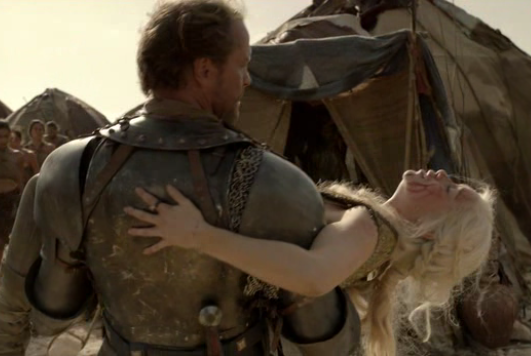
               While the idea of a lump child has not (in my experience) been extensively dealt with in modern media, that is not to say that The King of Tars hasn’t made any “appearance” in recent years. In fact, an interesting parallel can be drawn between this middle English narrative and certain occurrences in the extremely popular novel/television series Game of Thrones. Specifically, it is the interactions between Daenerys and Khal Drogo (as well as the general narrative surrounding these individuals) that I would draw your attention to. This arc portrays a sort of perversion of the original story, though retaining many of the key elements.
               The first thing to consider is the marriage itself. In both cases, the audience is presented with a foreign/pagan king who seeks out a white/Christian princess to be his bride based upon her beauty. However, in The King of Tars the King only offers his daughter away after his people and lands are threatened with violence by Sultan Laban, whereas in Game of Thrones it is Viserys (essentially the King of Tars in this situation) who bargains away his sister (the princess) to Drogo to gain the Khal’s troops and support for his plans to retake Westeros. This situation presents the first example of the switching of roles in this modern interpretation of the piece, with the role of aggressor being moved from the Dothraki (Saracens) to the Targaryens (Christians).
               There is also the matter of “conversion” to consider. Unlike the princess in K.o.T., Daenerys seems much more truly willing to adopt the culture and practices of her new people. The Targaryen princess adapts to the Dothraki style of clothing, and in time and with practice becomes versed in the language. This once again presents a parallel between the two works, as the princess does much the same in the K.o.T. (while language is not specifically mentioned in the middle English text, I feel it is safe to assume based on the context that the princess would have likely had to adapt her speaking at least in some way when transferred from a European/Christian world to that of the Saracens). However, the two differ in their adoption of the cultures religion. While Daenerys seems willing to learn and to a degree embrace the Dothraki faith, the princess only pretends to convert and states that she really held Christ in her heart the whole time. This change will play an interesting role in the conclusions of these pieces.
               Then, of course, there is the matter of the child itself. In both cases, the audience is presented with a “monster” child, with the princess giving birth to a lump and Daenerys giving birth to a scaled, blind, batwinged creature filled with grave worms. In both cases, these malformations can be linked to a “break of faith” of sorts. However, while Sultan Laban is the apparent cause of this misfortune in K.o.T., due to his non-Christian faith, in G.o.T. it is Daenerys who leads to the malformed child. The Targaryen girl, in a bid to save her husband’s life, consorted with “dark magic” which twisted and consumed the infant. While these magics do not originate in Daenerys faith, she still is the one who seeks out the practitioner capable of their use, thus taking on the role of the “heretic” in that narrative. However, potentially one could consider the burning of Khal Drogo and the birth of the dragons following the sacrifice of the child to be the equivalent of the baptism in K.o.T., with the previously monstrous child/failed resurrection only being righted after undergoing this ritual.

               I find it interesting that in what could be considered a modern take on this middle English romance it is the Christians (Targaryens) who conform to the medieval negative ideals often associated with the Saracens. This change is likely an attempt to avoid the racism and Christian-superiority evident in the original text, although more research would be required to flesh out and verify/validate this theory.
Persian Portrayal in the movie "300"


300,  a dramatic film directed by Zack Snyder of the legendary battle of Thermopylae in Greece, involves three hundred brave Greek heroes squaring off against legions of monstrous Persian warriors in order to save their homeland. Many elements of the story, of course, have been exaggerated for the sake of making a blockbuster hit, but the most fascinating part of the film involves the way Snyder chose to portray the "enemy", the Persians, and the "heroes", the Spartans. Many of his choices reveal bias that seems to translate over from medieval portrayals of Saracens, while the heroes are given qualities that they, as bloodthirsty Greek warriors, may not have had in the first place.


The Persians are depicted as dark-skinned, sexually depraved, even monstrous creatures, with their leader Xerxes dressed flamboyantly and enjoying a harem of women, some of whom have physical deformities. Indeed, even Xerxes' ranks of soldiers include a two-headed monster. Many soldiers also wear masks, which dehumanize them even more (much like Storm Troopers in Star Wars). Xerxes also dresses very richly, wearing lavish armor and piercings, and he sits on a high throne even during battle, which indicates that he considers himself worthy of worship. He is inhuman and even sexually threatening. Even the cinematic effects involved in portraying the Persians are dark and tend to obscure their features, making them even less human. This distancing reminds me of the portrayal of Saracens in the works we've read so far: very rich, usually sexually driven (King of Tars, Sultan of Babylon) and very much inhuman. Snyder has stated that he wished to make the Persians more intimidating and monstrous, which makes senses from a director's perspective. What's curious are the ways he went about it.


On the other hand, Snyder had to humanize the Spartan forces. The Spartan warriors are famed for their discipline, but historically they were not great people. They disposed of babies which were not physically perfect, they killed one another as a matter of course, and they lived and breathed war. Snyder contrasted them with the Persians by making them austere and disciplined, fighting mostly naked against the heavily armed Persian forces, making them seem brave. They are also contrasted with the other Greeks they're defending, who are portrayed as "soft." The leader, Leonidas, is portrayed as a tough, incorruptible man of the people, fighting alongside his soldiers instead of atop a throne, as Xerxes does. It's also difficult to ignore that Xerxes is portrayed by a black man when it's more likely that he would have appeared Middle Eastern, while Leonidas, who was Mediterranean and would have had darker skin, is portrayed by the lily-white, Scottish Gerard Butler. This disciplined, white, uncorrupted model hearkens back to the portrayals we've seen of Christian leaders which fight against Saracens in the works we've read.

It seems that medieval visual prototypes of "good" and "bad" are still very much alive in popular media today.


Monday, October 27, 2014

It's miraculous.... at least it was in the King of Tars


In Christianity miracles are seen to be these glorious gifts from God, and let's all just admit it that in The King of Tars, when that baby was born they surely needed something.
The baby that was born in the King of Tars was this lump, (still unsure what it would look like but I'm going with this fleshy little ball that if you dropped it and a hill was around, it'd probably roll.) and the sultan and the princess decided to have this pray off to see whose God would come through and make their baby a human.
King of Tars, Sultan praying to the idols.
Deformities were seen to be the fault of the mother, who while pregnant had dreams that contained sexual thoughts that were impure, that they were sexually active with multiple partners, or that they were into witchcraft and were in cahoots with the devil. Children born with deformities were called "Changelings" and that they were human children switched with the Devil's substitutes because the mother either slept with Satan or both parents were into the black magic. In our story the issue could be seen is we have two different religions coming together, Christianity and Paganism. The Princess is visited by Jesus in a dream and saved from a demonic hunt and is reassured in her faith that she pretends to convert and keeps her Christian religion as her true religion in her heart. So she sleeps with the Sultan who isn't Christian and their blood mixes and well the outcome is less than desirable.
So the Sultan prays to his idols and Gods to help his son and nothing happens and he gets angry and breaks the idols. The Princess has a priest come and he baptizes the baby and the next thing we know boom a miracle. The baby has flesh, a face and limbs. We have a real life baby. The miracle gives the Sultan and the Princess a child and convinces the Sultan to forsake his religion and convert to Christianity, which for the Princess is a miracle in itself.
The actual transformation of the child is a divine vision of the miracle performed and is often used to bring the reader in and used for conversion purposes. It takes things that are seen as monstrous and dangerous and through faith and God brings it to something that is miraculous.
When looking to the miracle it also seems to protect the protagonist because the baby links her to witchcraft and evil entities with the devil and by the miracle she's able to turn it to good and use it towards her cause of not only converting others to Christianity but saving her child and in the end her husband. 

Work Cited: Magic and the Supernatural in Medieval English Romance Corinne Saunders

Tuesday, October 7, 2014

The Contradictory Virgin Mother

The cult of the Virgin Mary in the Middle Ages seems incredibly out of place. This was a time where women were thought to be disgusting, dirty and even evil. But where Christians were trying to keep themselves separate and pure from their Jewish neighbors Mary came in as a mediator and saving grace. She did this both by saving said Christians from the Jews and by allowing these Jews a way of conversion. As the stories like “The Prioress’ Tale” and “The Child Slain by Jews” go, the Jews would kill a Christian child, a boy, and Mary would come to save him for his honor of her - with her seed or flower placed in his mouth/throat. But why Mary and not Jesus, a man and savior to the Christians? The answer lies in the contradiction that Mary is. She is a Virgin Mother. She saves the Christian boy by both seed and flower - male and female. She gives birth only to give her son to death. But most importantly she is saving and condemning, together. These stories end in the saving of Christians from their Jewish neighbors, but the young boy still dies, and more importantly the Jewish murderers are all put to death.


But this is not unique to the Middle Ages - let's look at Our Lady of Guadalupe, who gave Saint Juan Diego roses in bloom in the middle of the winter. The context she first appeared in at Guadalupe was very similar to the one in the Middle Ages. The Spanish Catholic conquest of Mexico was "threatened" by the indigenous Aztec population. With the violence of this conquest the Aztecs planned to revolt against and kill the Spaniards and this is where Mary comes in. By appearing to Juan Diego, a native of the land, adorned with Aztec symbolism and speaking to him in his native tongue Nahuatl while also charging him with the building a church on a hill northwest of Mexico City where she appeared to him, her goal was to convey her presence amount the local indigenous people. Her visitations had the effect of converting almost the entire Aztec population to Christianity - effectively ridding the Christians of the threat of pagans and spreading the faith. But, because of her appearance during her visitations the indigenous people of Mexico claimed her as their own as well – seeing themselves in her dark skin and eyes. And so she constructed a blended and new identity for the Mexican people.


This veneration of Mary has since spread to the United States with immigrants from Mexico. We find her especially in Los Angeles – on bumper stickers, hanging from rear-view mirrors, in street art and most notably on the arms, chests and backs of Hispanic gangsters. She has somehow moved from representing just conservative Christians to now also artists and gangsters. The tattoos of the Virgin Mary of Guadalupe on a gangster’s skin slow him to be both holy and dangerous, a sinner and saint. She, as a grace giving mother, becomes a sort of home for those who are out of place. Her darker skin color, while depicted in America, gives a home and voice to those outside the majority. And once she is imprinted on the skin she becomes, not only a necessary means of gang identification but also shows the compassion she stands for, because these gangs are often the only place where these Mexican immigrants have a sense of belonging.
 

Her power and popularity seems to come in her ability to mediate contradictions - she can be a saving grace, a converting force while not condemning some pretty horrendous acts - whether it be persecution of Jews or gang violence. It seems as though, while Mary can represent some wonderful things and at times be a connection between disparate cultures and religions (think of the way the Islamic faith venerates Mary) she can also be used to forward a cultures own agenda.

Bodies


Carolyn Dinshaw suggests in “Pale Faces: Race Religion, and Affect in Chacer’s Texts and Their Readers” that in The Man of Law’s Tale is a belief that the color of your skin had a direct correspondence with the religion that you practiced. This perceived relationship was paleness/whiteness with Christianity and a non-whiteness with Islam. This relationship between skin and the body with religious faith is present in Stronghold Crusader, an R.T.S. (real time strategy) videogame, set during the crusades.
In the 50 mission campaign of Stronghold Crusader, the gamer is presented both European and Arabian opponents to overcome. While playing the game, these enemies will dialogue with you, appearing in the right hand corner of the screen so you can see them as they speak. Though there is no relationship between the bodies of the European opponents and Christianity, there is a relationship between the bodies of the Arabian opponents and Islam, which effects the threat that these opponents pose the player.
Though the context of the games is the crusades, there is an interesting absence of religious imagery or reference in the game. The gamer may assume that the Arabian characters are Muslim and that the European characters are Christian, but this distinction is almost never explicitly made within the game. There is only one character within this game that has been given any explicit, religious context, The Caliph.
This title, caliph, has a particular religious significance. A caliph was a political and religious leader who ruled in accordance to Islamic law. After the death of Muhammad this was the title given to the political leaders who succeeded him as the rulers of the Islamic state (the caliphate). The character, The Caliph, is extremely aggressive, whether he is fighting against you or fighting along side you. His military strategy is brutal: he is one of the few characters to throw boiling oil over his walls on attackers, and is the only character who will put pitch on the ground to light enemies on fire if they come too near his walls. He is cruel in his economic strategy as well, using the games negative aspect of its “fear factor” system to bully his civilians into working harder by building dungeons, stocks, and various torture devices to frighten them. When he speaks he issues threats and insults in his dialogues with the player.
This aggression makes The Caliph a very formidable opponent to the gamer. Whenever we see him on the screen as he speaks, we see that his body is incredibly dark. The gamer can see his dark body as he threatens violence and refers to the gamer as “infidel”. He is always in a posture of aggression, wielding a sword, shaking his fist, or glaring.
The Caliph contrasts dramatically with only other non-historically specific, Arabian character, The Sultan. This title, sultan, is a title that also denotes a position of leadership but has a more secular context than the title of caliph. The Sultan is an extremely agreeable character, both as an ally and, amusingly, as an enemy. The majority of The Sultan’s dialogue is poetic, featuring naturalistic metaphor and analogy. He is never rude or aggressive in his address regardless of whether he is working with you or against you. Likewise the Sultan’s economic strategy reflects his good nature; he uses the positive dynamic of the game’s “fear factor” system to build flowerbeds and statues to increase his popularity with his people.  
The Sultan is very peaceable, and as such, is a much easier enemy for the gamer to battle against. In every dialogue with The Sultan, his body is much lighter in comparison to the body of The Caliph just as the threat he poses is much lighter. His light body is always relaxed, he gesticulates in a friendly manner, and his body is always framed in a peaceful setting.
The bodies of these characters are a reflection of the threat that these characters pose to the gamer. Through his title, the character The Caliph has been framed in a religious context, whereas the Sultan has nothing that explicitly ties him to what we may infer is his faith. This religious affiliation has a direct relationship to the respective darkness and lightness to the Muslim bodies of these persons within Stronghold Crusader. Just as in The Man of Law’s Tale, we see a direct relationship here between the body and religious faith.


https://www.youtube.com/watch?v=O1z5gjCqXvI- The Caliph
https://www.youtube.com/watch?v=q7Vfi224668 - The Sultan

Monday, October 6, 2014

The Sword and the Stone: Disney's Version of Medieval Christianity


tale Geoffrey of Monmouth presents. In The Sword and the Stone Merlin is an elderly man, Arthur apparently has no parents and is raised as a servant in a castle, and Arthur becomes king not because of his personality or his bravery, but because he manages to pull a sword out of the stone (hence the title). However, what does stay consistent between Geoffrey’s tale and the Disney movie is Arthur’s undeniably Christian persona: humble, forgiving, loving, and very white.
            Tales of medieval Christianity were very much focused on the forgiving nature of Christians, as opposed to the harsh and angry nature of the Jews. In “The Jewish Boy” the Jews and the Christians are starkly contrasted when the Jewish father tries to put his own child in the oven, and that same Jewish child is saved by Mary, the mother of all Christians. The Jew (the father) doesn’t have a problem killing his child while the Christian (Mary) saves a boy that is not even of the same religion. The forgiving and loving nature of Christians in “The Jewish Boy” is the same forgiving and loving nature that Arthur shows in The Sword and the Stone. At the end of the movie, after everyone realizes Arthur is meant to be king, Sir Ector, who has belittled and mocked Arthur the entire movie, gets on one knee and apologizes to Arthur for how he has treated him. Arthur immediately forgives Sir Ector, saying he doesn’t have to apologize for anything. This is exactly the kind of image medieval Christians wanted the world to have of Christianity: humble, kind and forgiving. Obviously, the actual Christians were less forgiving and humble and more brutal and murderous, but they attempted to give the appearance of humility and kindness in stories with characters such as King Arthur.
            We’ve talked in class about how many stories focus on young boys. “The Jewish Boy,” “The Prioress’s Tale,” and “The Child Slain by Jews” all focuses on young boys, two Christians and one Jewish. These boys all have the same character traits: innocence, naivety and kindness. Arthur fits in perfectly with these boys; he’s not really sure what’s going on, he doesn’t know or care if he’s special; he’s just trying to make everyone around him happy. Just like the boy in “The Jewish Boy” who goes into the church because it looks beautiful, or the boy in “The Prioress’s Tale” who sings so he can give praise to Mary, everything Arthur does contains a certain element of wonder and love, from when he turns into random animals with Merlin, to when he tries to figure what to do as king. This persona of wonder and love ties back into the Christianity that the medieval Christians tried to advertise. There is no maliciousness or evilness in Arthur’s actions, just love, which is what Christians argued all people would be like once they became a “child of Christ.”
 As a young boy Christian, Arthur is also the most precious and valuable of all human beings: he is not corrupted by sin like some men, he is not a woman, so he doesn’t need to worry about the sinfulness of menstruation or having a vagina, and he doesn’t have to worry about going to hell like the Pagans, Muslims and Jews. He is simply just a young boy, trying to do what’s right in the world. Although it is never explicitly stated that Arthur in The Sword in the Stone is a Christian, the actions he takes and the words he says makes it clear that Arthur is shaped by the ideals of medieval Christianity.