Showing posts with label Saracen. Show all posts

Tuesday, October 28, 2014

Re:mixed people (pun intended)

In this course we have looked at a few different stories that discuss what people in the Middle Ages may have thought about children born of interracial couples and the reflection skin color has on character. In The King of Tars the child that is born of a Christian mother and a Saracen (Muslim) father is literally a formless, monster baby. In the Man of Laws tale the child magically becomes pure white after being baptized.

One story we haven't read in class, though Professor Blake has mentioned it several times, is Wolfram Von Eschenbach's Parzival. Eschenbach takes a contrarian stance on the issue of interracial marriage in the form of Parzival's half brother Feirfiz. Feirfiz is the product of Parzival's Father's first marriage to the Moorish Queen Belecane. Because he has a European father and a Middle Eastern mother Feirfiz is said to have been born spotted. Eschenbach describes Feirfiz's complexion as being made up of white and black patches. His appearance is also compared to that of a magpie which sort of makes sense.

Despite Feirfiz's unusual complexion, he is never treated differently and is said to be quite handsome. He goes on to win a reputation for himself as the best knight in his land. He eventually takes his knighting skills over to Europe and unknowingly engages in a duel with his half brother. After Parzival breaks his sword over Feirfiz's helmet, the speckled knight refuses to continue because he would be forced to fight an unarmed man. The duel is declared a tie and the the combatants realize that they are half-brothers and become close friends. 

So, if Feiriz was so great despite being born of interracial marriage and not being a miraculous convert, why would Eschenbach create a speckled character? Perhaps the inspiration for his character really did have uneven pigmentation. There is a condition known as vitiligo that causes depigmentation of parts of the skin. This condition is fairly rare, affecting less than 1%, of the world's population. But, it is not uncommon and can affect people of any race. 

In 1986 Michael Jackson was diagnosed with vitiligo, a rare non-contagious disease characterized by pale patches on the skin. The causes are not known, but a range of genetic, auto-immune, and environmental causes are suspected.


Over the years Michael Jackson evolved from a charming, young, obviously African American performer into a different looking sort of personal altogether. It is thought that Jackson's case of vitiligo was a result of his use of skin bleaching products and a general lifetime effort of "beautification." Vitiligo is not always or caused by skin bleaching but it may be a contributing factor in some cases.


Music producer Quincy Jones, who worked with Jackson at the beginning of his transformation said, "It's ridiculous, man! Chemical peels and all of it. And I don't understand it. But he obviously didn't want to be black." Jackson's transformation is closest modern comparison to some of the stories we have read in which babies become white due to baptism (rebirth in Anglo-Christian culture). 

Maybe Feirfiz was a real person and Eschenbach assumed that their skin was that way due to mixed heritage. Maybe Eschenbach knew someone who had vitiligo and wanted to write a story in which someone who had speckled skin was as awesome as someone who was white. One thing is for sure though, the myths that people believe about character being a product or reflection of skin color still exist and in real life transformations aren't miraculous. 

H2WOAH: Miracles and Baptism


In the picture above, it may look like a man in a dress is getting ready to boil a baby for supper. But do not fret- this man is just a priest performing a paedobaptism (or infant baptism). What is baptism exactly? According to Christian belief, a baptism is a holy ceremony in which a Priest blesses a person using water. The person being baptized professes Jesus as his or her savior, and in return, that person is cleansed of his or her sins. The rules and rituals of baptism differ from sect to sect, but many believe that one must be baptized in order to enter Heaven.


(Click this link to watch a baptism.)

Aside from opening the pearly gates and washing away sins, there have been many stories of baptisms aiding in the performance of healing miracles. One of these stories is called The King of Tars which tells of a Christian princess and a Saracen king producing a blob baby. This baby lacks blood, bones, and basically all the parts that a normal, healthy baby would have. However, the blob is baptized, and it miraculously turns into an actual baby. 

--->  --->  
             
While The King of Tars was written long ago, there are modern day stories of healing through baptism. For instance, an article from 2011 tells the story of a girl who suffered a brain hemorrhage. She was taken off life support and expected to die shortly thereafter, but her family opted to have her baptized before she passed. Instead of dying after her baptism, she made a miraculous recovery. Another example can be seen in this video which shows a woman claiming her cancerous tumor disappeared after being baptized.

Despite the validity of any of these stories, people still believe in the power of baptism. This continuous belief is just one aspect that connects The King of Tars to the present day. Even though this story was told years before our time, the ideas and morals referring to baptism or religious conversion portrayed in The King of Tars are still significant today. By simply Googling "baptism miracles" or watching a live-action baptism at a local church, one can see that this ritual holds great significance in the Christian faith. The present contains residual elements from the past, so old texts such as The King of Tars are important in understanding different beliefs and practices that exist in modern society.

The King of Tars in Modern Media: Daenerys and Khal Drogo

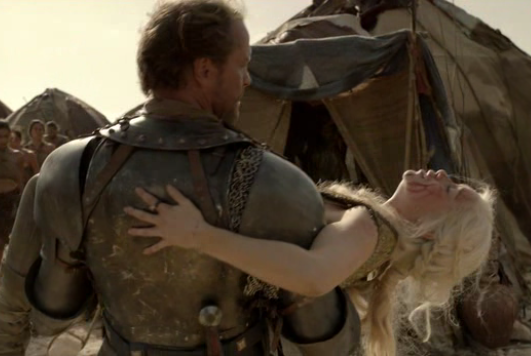
               While the idea of a lump child has not (in my experience) been extensively dealt with in modern media, that is not to say that The King of Tars hasn’t made any “appearance” in recent years. In fact, an interesting parallel can be drawn between this middle English narrative and certain occurrences in the extremely popular novel/television series Game of Thrones. Specifically, it is the interactions between Daenerys and Khal Drogo (as well as the general narrative surrounding these individuals) that I would draw your attention to. This arc portrays a sort of perversion of the original story, though retaining many of the key elements.
               The first thing to consider is the marriage itself. In both cases, the audience is presented with a foreign/pagan king who seeks out a white/Christian princess to be his bride based upon her beauty. However, in The King of Tars the King only offers his daughter away after his people and lands are threatened with violence by Sultan Laban, whereas in Game of Thrones it is Viserys (essentially the King of Tars in this situation) who bargains away his sister (the princess) to Drogo to gain the Khal’s troops and support for his plans to retake Westeros. This situation presents the first example of the switching of roles in this modern interpretation of the piece, with the role of aggressor being moved from the Dothraki (Saracens) to the Targaryens (Christians).
               There is also the matter of “conversion” to consider. Unlike the princess in K.o.T., Daenerys seems much more truly willing to adopt the culture and practices of her new people. The Targaryen princess adapts to the Dothraki style of clothing, and in time and with practice becomes versed in the language. This once again presents a parallel between the two works, as the princess does much the same in the K.o.T. (while language is not specifically mentioned in the middle English text, I feel it is safe to assume based on the context that the princess would have likely had to adapt her speaking at least in some way when transferred from a European/Christian world to that of the Saracens). However, the two differ in their adoption of the cultures religion. While Daenerys seems willing to learn and to a degree embrace the Dothraki faith, the princess only pretends to convert and states that she really held Christ in her heart the whole time. This change will play an interesting role in the conclusions of these pieces.
               Then, of course, there is the matter of the child itself. In both cases, the audience is presented with a “monster” child, with the princess giving birth to a lump and Daenerys giving birth to a scaled, blind, batwinged creature filled with grave worms. In both cases, these malformations can be linked to a “break of faith” of sorts. However, while Sultan Laban is the apparent cause of this misfortune in K.o.T., due to his non-Christian faith, in G.o.T. it is Daenerys who leads to the malformed child. The Targaryen girl, in a bid to save her husband’s life, consorted with “dark magic” which twisted and consumed the infant. While these magics do not originate in Daenerys faith, she still is the one who seeks out the practitioner capable of their use, thus taking on the role of the “heretic” in that narrative. However, potentially one could consider the burning of Khal Drogo and the birth of the dragons following the sacrifice of the child to be the equivalent of the baptism in K.o.T., with the previously monstrous child/failed resurrection only being righted after undergoing this ritual.

               I find it interesting that in what could be considered a modern take on this middle English romance it is the Christians (Targaryens) who conform to the medieval negative ideals often associated with the Saracens. This change is likely an attempt to avoid the racism and Christian-superiority evident in the original text, although more research would be required to flesh out and verify/validate this theory.
Persian Portrayal in the movie "300"


300,  a dramatic film directed by Zack Snyder of the legendary battle of Thermopylae in Greece, involves three hundred brave Greek heroes squaring off against legions of monstrous Persian warriors in order to save their homeland. Many elements of the story, of course, have been exaggerated for the sake of making a blockbuster hit, but the most fascinating part of the film involves the way Snyder chose to portray the "enemy", the Persians, and the "heroes", the Spartans. Many of his choices reveal bias that seems to translate over from medieval portrayals of Saracens, while the heroes are given qualities that they, as bloodthirsty Greek warriors, may not have had in the first place.


The Persians are depicted as dark-skinned, sexually depraved, even monstrous creatures, with their leader Xerxes dressed flamboyantly and enjoying a harem of women, some of whom have physical deformities. Indeed, even Xerxes' ranks of soldiers include a two-headed monster. Many soldiers also wear masks, which dehumanize them even more (much like Storm Troopers in Star Wars). Xerxes also dresses very richly, wearing lavish armor and piercings, and he sits on a high throne even during battle, which indicates that he considers himself worthy of worship. He is inhuman and even sexually threatening. Even the cinematic effects involved in portraying the Persians are dark and tend to obscure their features, making them even less human. This distancing reminds me of the portrayal of Saracens in the works we've read so far: very rich, usually sexually driven (King of Tars, Sultan of Babylon) and very much inhuman. Snyder has stated that he wished to make the Persians more intimidating and monstrous, which makes senses from a director's perspective. What's curious are the ways he went about it.


On the other hand, Snyder had to humanize the Spartan forces. The Spartan warriors are famed for their discipline, but historically they were not great people. They disposed of babies which were not physically perfect, they killed one another as a matter of course, and they lived and breathed war. Snyder contrasted them with the Persians by making them austere and disciplined, fighting mostly naked against the heavily armed Persian forces, making them seem brave. They are also contrasted with the other Greeks they're defending, who are portrayed as "soft." The leader, Leonidas, is portrayed as a tough, incorruptible man of the people, fighting alongside his soldiers instead of atop a throne, as Xerxes does. It's also difficult to ignore that Xerxes is portrayed by a black man when it's more likely that he would have appeared Middle Eastern, while Leonidas, who was Mediterranean and would have had darker skin, is portrayed by the lily-white, Scottish Gerard Butler. This disciplined, white, uncorrupted model hearkens back to the portrayals we've seen of Christian leaders which fight against Saracens in the works we've read.

It seems that medieval visual prototypes of "good" and "bad" are still very much alive in popular media today.